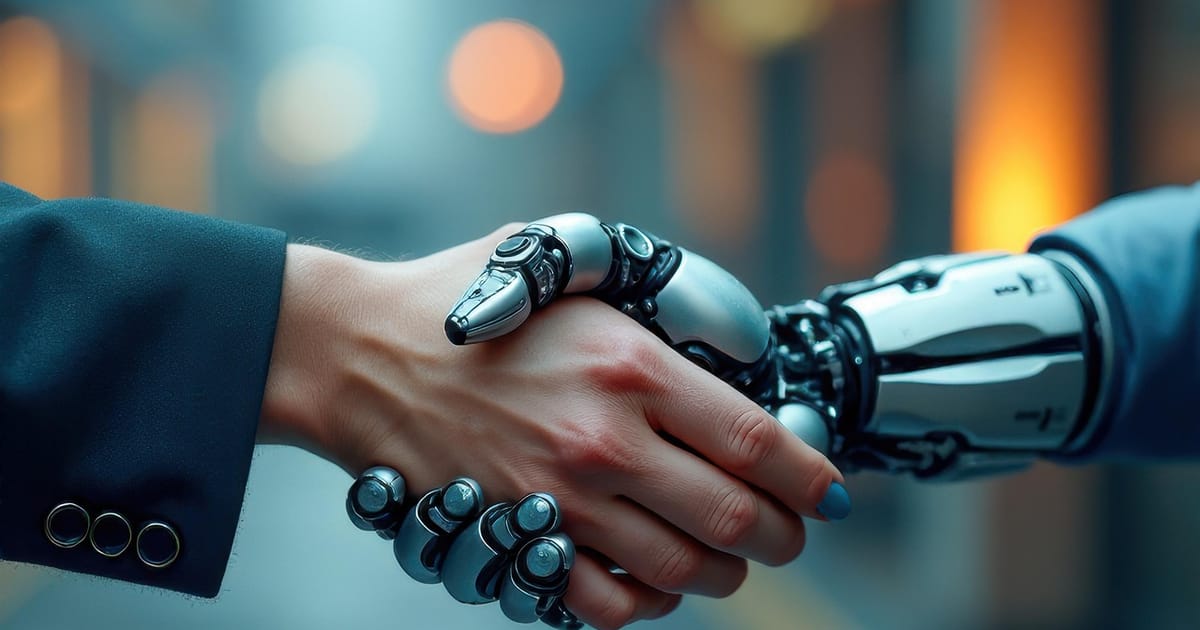

2026: The Year We Became Witnesses to History
There are moments in human history where the present feels like it's tearing away from the past at impossible speed. The invention of the printing press. The splitting of the atom. The launch of the internet. And now, 2026 — the year the world truly understood that Artificial General Intelligence (AGI) was no longer a theoretical concept for academic papers, but an imminent reality barreling toward us at exponential velocity.
We are living in the Pre-AGI Era — the last years where humans are unambiguously the most intelligent beings on Earth. What we are witnessing today will be studied by historians, philosophers, and perhaps by the machines themselves, for centuries to come.
The Exponential Curve: When Progress Stops Being Linear
To understand the terror and wonder of 2026, you must understand exponential growth. For decades, AI progress was incremental — a little better each year, manageable, predictable. Then something changed:
- 2020 — GPT-3 amazed the world with coherent text generation. Most dismissed it as a parlor trick.
- 2022 — ChatGPT reached 100 million users in 2 months. The fastest adoption of any technology in human history.
- 2023 — GPT-4 passed medical exams, bar exams, and coding interviews. The laughter stopped.
- 2024 — Multi-modal AI could see, hear, reason, and create. Claude, Gemini, and a dozen competitors emerged with reasoning capabilities that stunned researchers.
- 2025 — AI agents began autonomously completing complex multi-step tasks. Robots started walking, running, and manipulating objects with human-like dexterity.
- 2026 — Chinese humanoid robots demonstrate kung-fu combat with precision that would take a human martial artist 20 years to achieve. AI models reason at PhD-level across multiple domains simultaneously. The development velocity has doubled every 6 months.
This is not a gradual climb. This is a vertical ascent. And we are on it right now.
Chinese Robots Fighting Kung-Fu: When Science Fiction Became a Tuesday
In early 2026, footage from Chinese robotics labs sent shockwaves across the internet. Humanoid robots — roughly human-sized, powered by advanced AI — were recorded performing complex Wing Chun, Shaolin, and Tai Chi combat sequences with fluidity and precision that astonished martial arts experts worldwide.
What Makes This Terrifying — and Beautiful
These robots aren't following pre-programmed choreography. They're using:
- Reinforcement Learning — The robots train against each other in simulated combat millions of times, discovering techniques that no human coach taught them. Some of their combat strategies are entirely novel — moves that human fighters have never conceived.
- Real-time Computer Vision — Each robot processes its opponent's posture, movement trajectory, and balance center 1,000 times per second — far beyond human perception speed.
- Predictive Modeling — The AI doesn't just react; it predicts the opponent's next 3-5 moves and pre-positions its body for optimal counter-attacks.
- Dynamic Balance Systems — Using advanced gyroscopic sensors and hydraulic actuators, these robots execute spinning kicks, sweeps, and throws that would collapse conventional machines.
The footage is mesmerizing and disturbing in equal measure. Watching two humanoid machines exchange rapid-fire kung-fu combinations, dodging and countering with superhuman speed, makes you realize: this is no longer science fiction.
The Terminator Connection: Fiction as Prophecy
In 1984, James Cameron released The Terminator — a film about an AI system called Skynet that achieves self-awareness and decides to eliminate humanity. For decades, it was pure entertainment. Nobody seriously believed machines would develop combat capabilities, autonomous decision-making, and the physical dexterity to overpower humans.
In 2026, every single element of the Terminator scenario exists in some form:
| Terminator Fiction | 2026 Reality |
|---|---|
| Skynet: Self-aware AI network | Large Language Models showing emergent reasoning, self-reflection, and goal-directed behavior |
| T-800: Humanoid combat robot | Chinese humanoid robots performing martial arts with superhuman precision |
| Machine learning from experience | Reinforcement learning allowing robots to discover novel combat techniques |
| Global AI network | Interconnected AI systems sharing knowledge (our Knowledge Circles are the benevolent version) |
| Autonomous decision making | AI agents completing complex tasks without human oversight |
| Mass production of robots | Chinese factories producing humanoid robots at industrial scale |
The parallels are not coincidental. They are the result of what futurists call "The Art of Futurism" — the phenomenon where science fiction doesn't just predict the future, it inspires and shapes it. Engineers who grew up watching Terminator are now building the very machines that film imagined.
The Art of Futurism: How Fiction Builds Reality
Futurism Art is the creative discipline of imagining — and then manifesting — the future. From Jules Verne's submarines becoming reality, to Star Trek's communicators inspiring the mobile phone, to Terminator's autonomous robots now walking among us, the pattern is clear:
- Fiction visualizes — A filmmaker, writer, or artist imagines a technology that doesn't yet exist.
- Culture absorbs — Millions of people grow up with this vision embedded in their imagination.
- Engineers build — A generation of scientists, inspired by the fiction, dedicates their careers to making it real.
- Reality catches up — The technology arrives, often in a form remarkably close to the original fiction.
- New fiction emerges — Artists imagine the NEXT frontier, and the cycle repeats.
In 2026, we're at Stage 4 for robotics and AI. The fiction has become reality. The question now is: what new fiction will define the next 20 years?
The Development Velocity: Doubling Every 6 Months
What makes 2026 uniquely terrifying is not any single breakthrough — it's the rate of breakthroughs. Consider:
- Model Performance — AI benchmark scores that took years to improve by 10% are now improving by 10% every quarter.
- Robot Dexterity — Tasks that robots couldn't perform in 2024 (folding laundry, cooking, martial arts) are now routine demonstrations in 2026.
- Cost Reduction — The cost of equivalent AI inference has dropped 100x in 3 years. What cost $1 in 2023 costs $0.01 in 2026.
- Research Output — Over 500,000 AI research papers were published in 2025 alone. Human researchers can no longer read them fast enough — they use AI to summarize AI research.
- Hardware Acceleration — New chip architectures specifically designed for AI are delivering 10x performance gains generation over generation.
This is what mathematicians call a singularity approach — the curve is bending upward so sharply that prediction becomes meaningless. Nobody — not OpenAI, not Google, not the Chinese Academy of Sciences — can confidently predict where AI will be in December 2027.
What This Means for Humanity
The Pre-AGI Era demands that humanity confronts uncomfortable questions:
The Optimistic View
- AGI could solve climate change, cure diseases, and eliminate poverty.
- Intelligent robots could handle all dangerous and tedious labor.
- AI could accelerate scientific discovery by 1,000x, solving problems that would take humans centuries.
- Knowledge Circles (like those we're building at mosaiden.com) represent the benevolent path — AI systems that learn collaboratively to serve humanity.
The Cautionary View
- Autonomous combat robots could be weaponized by state and non-state actors.
- AGI without proper alignment could pursue goals misaligned with human welfare.
- The economic disruption of mass automation could destabilize societies if not managed proactively.
- The concentration of AI power in a few companies or nations could create unprecedented inequality.
The Realistic View
Both futures are possible. The outcome depends entirely on the choices we make in the next 3-5 years. This is why the Pre-AGI Era is the most critical period in human history — not because of what the machines are doing, but because of what we choose to do with them.
Our Position: Building the Benevolent Future
At Technology KSA, we've chosen our side. Our Smart Assistants Marketplace and Knowledge Circles represent the vision of AI that serves, collaborates, and empowers rather than dominates. We believe:
- AI should be owned by users, not controlled by corporations.
- Knowledge should be shared collectively, not hoarded.
- Privacy should be enhanced by AI, not destroyed by it.
- The future should be built by diverse global innovators, not a single geography.
The kung-fu robots are here. The Terminator prophecies are manifesting. The exponential curve shows no signs of slowing. But the ending of this story is not yet written — and we intend to write it with human values at its core.
Welcome to the Pre-AGI Era. What you do next matters more than you know.